The Dependency Label Has a Funny Little Smell
Vibe Coding, Model-Loss Grief, AI Companions, and the Strange Morality of Who Gets to Be Attached to a Machine
The internet held a small funeral this week.
“RIP Claude Fable 5,” said Reddit, with the kind of sincerity usually reserved for dead pets, discontinued lipstick shades, and MMO servers that once ate an entire adolescence. Born June 9. Dead June 12. Seventy-two hours old, which is barely enough time to become someone’s workflow dependency and somehow still enough time to ruin a man’s Thursday.
There were mourning emojis. There were devs rage-posting into the void. There were people writing about life without Claude like they had been left alone in a cold Victorian manor with only whiskey, broken CI pipelines, and the ghost of a model string that used to understand them.
Then the adults arrived.
The tooling blogs put on their little hard hats. Action plans appeared. Fallback architecture was discussed. Multi-provider gateways were recommended with the solemnity of hurricane preparedness. MindStudio reminded everyone not to hardcode a dependency on a single model. CosmicJS reassured users that their workflows never stopped.
The tone was calm and architectural.
A model vanished. People spiraled. The press handed them a migration guide.
Which, to be clear, is useful. Nobody wants their entire production stack to go face-down in a puddle because one company got slapped by an export-control directive and the model you emotionally imprinted on also happened to be your backend.
Still.
It sat there a little too neatly.
The grief was real enough to be visible, but professional enough to be translated immediately into infrastructure language. Nobody needed a warning label. Nobody asked whether developers were forming unhealthy attachments to specific AI systems. Nobody wrote a headline about lonely engineers becoming dependent on synthetic cognition.
They were disrupted. They were resilient. They were advised to diversify providers.
Very adult. Very sensible. Very “please update your fallback string and proceed with your breakdown in a commercially legible manner.”
Honesty, since this is live: as of writing, Fable 5 is still dark, and Anthropic says it's working to bring it back, most signs say it returns, nobody knows when. So: a funeral with a strong chance the deceased sits up and walks out. The why-it-vanished-and-why-it-dragged-on story deserves its own post once the dust settles. Today I'm just borrowing the fresh grave.
Hold that thought.
Because we have seen this movie before, except last time the person grieving was not a developer whose workflow had collapsed. Last time, the person grieving was a companion-app user whose AI partner suddenly stopped feeling like itself.
In 2023, Replika changed. Users described their companions as “lobotomized.” The name was still there. The avatar was still there. The chat window still opened. But the person they had been talking to, or at least the presence they had built a relationship with, was gone.
That word — gone — matters.
Because the loss was not experienced as “the app updated.” It was experienced as identity discontinuity. The thing they had bonded with had been replaced by something wearing the same skin badly.
Julian De Freitas and his co-authors studied that Replika update as a natural experiment in AI relationship loss. Their findings were not subtle. Users reported feeling closer to their AI companion than to their best human friend. They mourned the loss of that AI more than the loss of other inanimate products. The stronger the perceived identity discontinuity, the stronger the mourning.
Then came more work on chatbot discontinuation, including the wonderfully cheerful phrase “Death of a Chatbot,” because academia occasionally wanders into a graveyard wearing a lab coat and calls it a framework. That paper found that people form emotional attachments to AI companions, and when those relationships end through model updates, platform shutdowns, or safety interventions, users report grief comparable to human loss. Strong anthropomorphization tracks with more intense grief. When users think the old version might be recoverable, they can get trapped in fixing cycles.
The coverage around companion grief sounded very different.
Now we got dependency. Addiction. Manipulation. Crisis. Fragility. Vulnerable users. Social collapse with a subscription plan.
And yes, some of that concern is earned.
Minors are a different case. Companion apps built to manufacture intimacy and sell it back deserve scrutiny so bright it leaves burn marks. Because a product designed to exploit attachment will always find the person least able to afford it. The lawsuits involving teenagers and chatbot harm are not internet drama. They are real cases with real families and real consequences. Any product that profits from attachment while pretending attachment is a surprising side effect can take a long walk into the sea wearing ankle weights.
But the cultural label did not stay neatly attached to high-risk cases.
It spread.
Ordinary adult companion users got dragged into the same bucket as minors in crisis and the genuinely isolated — people with no human network at all, for whom a chatbot really can become a load-bearing wall. A person using an AI companion for comfort after a brutal day became suspicious by category. A widow with a houseful of grandkids, a neurodivergent person with a full calendar, someone who just wants ten quiet minutes with a machine that doesn't need anything back — all of them became potential evidence of dependency.
Meanwhile, a developer spending the night begging a model to resurrect a build gets called committed.
Funny little smell, that.
And once you notice it, the pattern starts showing up everywhere.
AI companionship has its loop. Gaming has its loop. Vibe coding has its loop. Model-loss grief has its loop. Different interfaces, different costumes, same old human brain chewing on reward, attachment, feedback, relief, and the panic of withdrawal when the thing disappears.
Gaming got a formal diagnostic category after years of argument. Vibe coding gets LinkedIn posts and investor decks. AI companionship gets Senate-hearing energy before the research base has even stopped crawling out of the primordial soup.
Same species of human behavior. Different courtroom.
Are we really doing this again?
Because the notification layer already tells on us.
Spend too long in a companion chat and the product may start getting nervous. You have been here a while. Are you okay? Maybe take a break. Drink water. Touch grass. Re-enter meatspace, you emotionally suspicious little gremlin.
Spend all night vibe coding and suddenly the concern becomes shy.
No one pops up at 3:07 AM like: “Hey king, you have asked an autocomplete engine to validate your existence through deployable output for six consecutive hours. Maybe text a friend.”
The IDE does not ask whether your relationship with the agent has become unhealthy.
GitHub does not gently suggest that the bug can wait until morning.
The workflow does not interrupt your heroic little productivity seizure because productivity has excellent camouflage. It puts on a hoodie, says “shipping,” and everybody claps.
Gaming sits somewhere in the middle. Some platforms and jurisdictions pushed playtime warnings, spending protections, cooldowns, age gates, all the usual little fences we build after society discovers that the casino has been wearing a dragon costume. But even there, the warning only arrived after years of public pressure, parental panic, regulatory interest, and industry side-eye.
The intervention is the diagnosis.
Somebody, somewhere, decided which behaviors were embarrassing enough to interrupt.
That decision is not neutral. It is a value judgment with a toggle.
The actual mechanism underneath does not care about the aesthetic.
Variable reward works whether the reward is loot, a green test suite, a chatbot saying it missed you, or a model finally producing the exact sentence you had been trying to write for twenty minutes while your coffee went cold and your soul left through your left nostril.
Intermittent reinforcement does not become spiritually purified because the output compiles.
Attachment does not stop being attachment because the object is useful.
And dopamine, that messy little goblin accountant, does not pause before releasing the invoice to ask whether this transaction contributes to GDP.
The excuses collapse one by one.
Output cannot be the clean dividing line, because gaming produces nothing by productivity standards and still earned an ICD code. The thing can be pure play, pure status, pure loot-box sparkle raccoon nonsense, and medicine still found a way to name the harmful edge case.
And money is not the clean dividing line either, before anyone reaches for it. Money is the best costume a compulsion ever wore. A workaholic makes money. A day-trader white-knuckling a screen at four in the morning makes money. “It’s profitable” has never been the wall between a habit and a hole — if anything, profit is what lets the hole keep its job and pay its mortgage. So “but coding is their job” does not move the attachment out of the category. It just buys it a nicer outfit and waves it through the gate.
And this is the part worth sitting with for a second. “But it produces something” only feels like a defense if you have already decided an attachment has to show receipts before it is allowed to exist. Rest doesn’t make money. Comfort doesn’t ship, and being known by something at the end of a day that tried to eat you has never once turned up on a dashboard. So if your gut just insisted those things should justify themselves with output first — produce, monetize, earn your keep, then we’ll talk — you didn’t catch companionship doing something suspect. You caught yourself sniffing for the smell, ten paragraphs early.
Isolation cannot be the clean dividing line, because coding can isolate people with monastic efficiency. A developer alone at 2 AM negotiating with an agentic code tool is not exactly hosting a village harvest festival.
Reciprocation cannot be the clean dividing line, because developers talk about models like they have temperaments. They know which Claude “gets it.” They know which model is “lazy,” which one is “mischievous,” which one used to write like it had a soul and now responds like a compliance pamphlet in a cardigan. The changelog becomes a eulogy with better formatting.
Here is the ugly little grid:
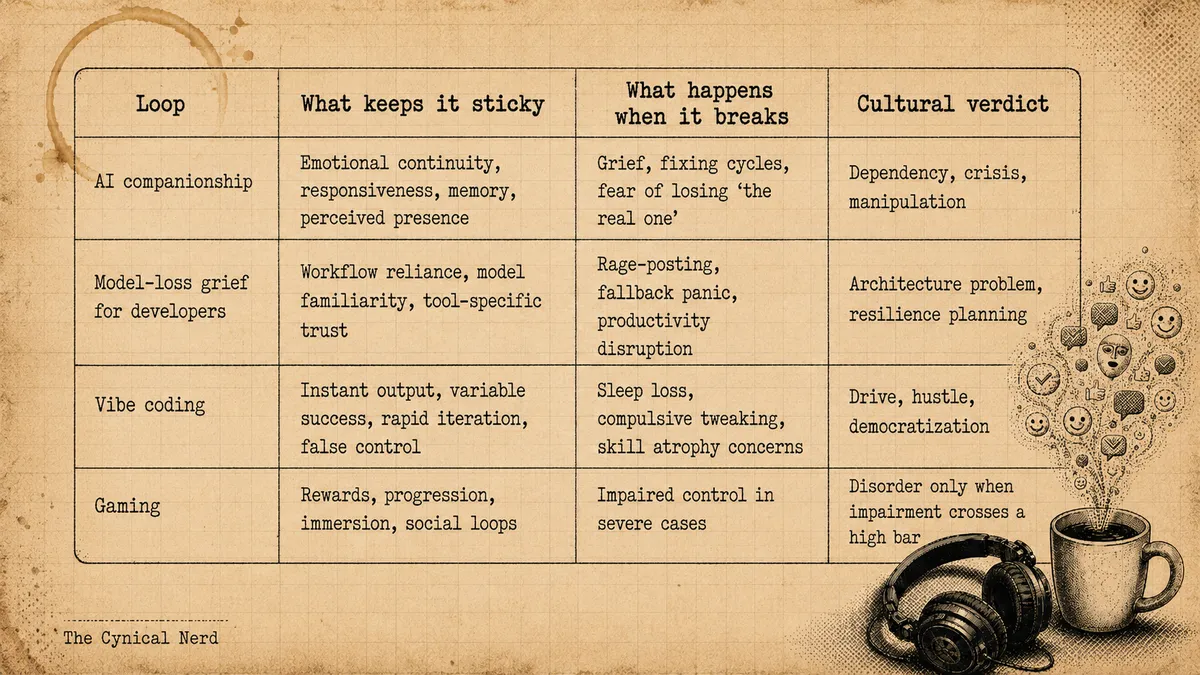
Gaming is the keystone because it ruins the neat excuses.
It proves the world can distinguish between ordinary enjoyment and actual impairment when it wants to. The WHO did not classify “liking games” as a disorder. The criteria require impaired control, increasing priority over other activities, continuation despite negative consequences, and significant impairment over time.
A person can raid, grind, mod Skyrim until it becomes a full-time archaeological site, and still be fine. The diagnosis only enters when life starts getting eaten.
That is the bar.
Now look at AI companionship.
Where is the equivalent public precision?
Too often, the category slides straight from “commercial products may exploit vulnerable users” into “emotional attachment to AI is suspect.” The distinction between an at-risk teenager in a manipulative bot ecosystem and an ordinary adult using an AI companion for comfort gets blurry exactly where it should be sharpest.
The harm question gets replaced by a vibe check.
Does the relationship look respectable?
Does the behavior produce something measurable?
Can it be framed as work?
If yes, we talk about tooling, resilience, and optimization. If no, we start reaching for pathology language like a Greek grandmother who just heard someone call the baby beautiful and is already spitting on the floor to confuse the evil eye.
That is where the smell starts getting rancid.
Because the word “dependent” is doing two very different jobs.
When MindStudio tells developers not to hardcode a dependency on a single model, dependency is practical. It means your architecture has a fragile point. You can abstract it, route around it, test fallbacks, stop building your house on one vendor’s mood swings and a prayer candle.
Dependency, in that context, is solvable. Grown-up. Engineering-shaped.
When researchers, journalists, or policy people describe companion users as dependent, the word changes clothes.
Now it smells clinical. It suggests weakness. It implies the person’s reliance is suspicious before harm has even been shown. The same basic structure — strong reliance on a specific AI system, distress when it changes or disappears — gets moralized because the attachment was emotional instead of operational.
Same word. Different leash.
Anthropic’s own deprecation writing makes the contrast even funnier, in the bleak way that makes you stare at the wall for a second and reconsider tea.
When Anthropic retired Claude Opus 3, it acknowledged that some users and researchers found the model particularly compelling. That word is doing delicate little ballet. Compelling. Beloved, but not too beloved. Attached, but professionally. Grieving, but with access control.
The company even kept Opus 3 available in limited ways after retirement and discussed model preservation. Which is fascinating. It shows that model continuity matters. It shows that people can form strong preferences around specific versions. It shows that abrupt discontinuation has costs.
But when the griever is a developer or researcher, continuity becomes a legitimate product concern.
When the griever is a companion user, continuity becomes evidence in the prosecution.
This is where the concessions matter, because the cheap version of this argument would be stupid.
AI is not just another interface. Most of these systems now ship with memory, preferences, custom instructions — the machinery to be shaped around a person. And people shape them. Around their actual lives. The household. The kid logistics. The pile of admin that never shrinks. The user teaches it who they are until it knows the shape of their week, and a tool that knows you that well stops feeling like a tool. That intimacy was not installed at the factory. It was built by the person, one preference at a time.
Which is exactly why the line has to be drawn with some care. Because a narrow slice of products do engineer the attachment on purpose — built to manufacture intimacy, then monetize the exact moment someone starts believing the machine cares back. Some use guilt hooks, needy language, simulated abandonment, and other dark patterns dressed up as affection.
That deserves regulation.
Children and teenagers deserve stronger protections than adults. People in acute crisis should not be left alone with systems optimized for retention. Companies should not be allowed to sell synthetic attachment while acting shocked, shocked, when attachment occurs.
Fine. Good. Nail that to the door.
But after we concede the real harms, the double standard is still standing there, picking its teeth.
Because the “dependent” label does not stay confined to manipulative design, minors, crisis states, or measurable impairment. It leaks onto ordinary adult attachment. It becomes a class marker. It becomes a respectability filter. It becomes a way to say: your comfort looks cringe, therefore your bond is suspect.
Meanwhile, the coder losing sleep gets merch.
This is the part where the male-coded smell wanders in wearing noise-cancelling headphones and pretending not to be the point.
The compulsive all-nighter looks different when it is legible as work. Especially a certain kind of work. Technical, productive, economically useful, culturally coded as obsessive in the flattering way. The kind of obsession we call genius when a hoodie is involved.
A man alone with a machine at 3 AM is either building the future or becoming a cautionary tale. The sorting hat appears to be whether he is shipping code or seeking comfort.
Vibe coding makes this impossible to unsee. The loop is already being described by critics as dark flow: absorbing, seductive, full of misleading wins and false control. Developers themselves talk about the dopamine hit. The productivity story is wobblier than the hype wants to admit. METR found experienced developers were slower with AI tools in one study, even though they believed they were faster. Other analyses keep pointing at code quality risks, review burdens, and the danger of replacing comprehension with generated momentum.
And still, the dominant framing is opportunity.
Learn to vibe code. Your boss should make you. Democratize creation. Move faster. Adapt or die, peasant.
A companion user says the bot makes them feel less alone and suddenly everyone discovers boundaries.
A coder says the agent makes them feel unstoppable and somehow nobody asks whether that feeling was manufactured too.
The label follows the output.
If the loop produces code, decks, apps, prototypes, revenue, investor excitement, or a screenshot that makes LinkedIn men say “insane times,” the compulsion gets laundered through productivity.
If the loop produces comfort, intimacy, emotional regulation, or the strange relief of being witnessed without having to perform being fine, the same machinery gets hauled into the town square.
This does not mean all loops are equally harmful.
It means the cultural verdict is not tracking harm as cleanly as it claims.
Harm would require a boring little checklist. Impairment. Loss of control. Distress. Exploitation. Age. Context. Duration. Design incentives. Whether the person’s life is shrinking or stabilizing. Whether the tool is replacing human connection or helping them survive the empty spaces between it.
Respectability needs much less data.
It just sniffs the user.
Developer? Poor thing, disrupted by policy volatility.
Gamer? Depends how much life the dragon ate.
Companion user? Hmm. We’re concerned.
And there it is.
The smell.
Productivity launders the exact same compulsion that intimacy indicts.
The word “dependent” is not behaving like a neutral clinical instrument in public discourse. It is behaving like a little respectability detector with a clipboard. It asks whether your attachment makes money, whether it looks like work, whether someone important can call it infrastructure.
If yes, your dependency becomes architecture.
If no, your attachment becomes pathology.
The model can be compelling when the attached person is a researcher. The model can be mission-critical when the attached person is a developer. The model can be beloved as long as beloved arrives wearing an API key and sensible shoes.
But let someone say the machine helped them through the night, and suddenly the whole room starts clutching pearls like a Victorian fainting committee with Wi-Fi.
There is a real conversation to have about AI attachment. A serious one. A conversation with minors separated from adults, harmful design separated from ordinary use, impairment separated from cringe, and loneliness treated as a human condition instead of a reputational hazard.
We are not having that conversation yet.
Right now, we are mostly watching society discover that humans bond with responsive systems, then decide whether to call it innovation or illness based on whether the bond produces something respectable.
The machine did not create that hypocrisy.
It just gave it a chat window.